



Prokineticin Receptor
Prokineticin Receptors (PKRs) are a class of G protein-coupled receptors comprising two subtypes, PKR1 and PKR2. They bind to endogenous ligands prokineticin (PK1 and PK2) and play pivotal roles in regulating various important physiological and pathological processes. Research has demonstrated that PKRs are critically involved in angiogenesis, neurogenesis, pain perception, reproductive functions, and circadian rhythm regulation[1].
PKR1 is primarily expressed in the cardiovascular system and peripheral tissues, where it participates in angiogenesis and cardioprotection, while PKR2 is predominantly distributed in the central nervous system, modulating neuronal development and synaptic plasticity . Upon activation, PKRs mainly signal through the Gq/11 protein-coupled pathway, stimulating phospholipase C (PLC) activation, which subsequently induces intracellular calcium release and protein kinase C (PKC) activation[2].
PKR1 is primarily expressed in the cardiovascular system and peripheral tissues, where it participates in angiogenesis and cardioprotection, while PKR2 is predominantly distributed in the central nervous system, modulating neuronal development and synaptic plasticity . Upon activation, PKRs mainly signal through the Gq/11 protein-coupled pathway, stimulating phospholipase C (PLC) activation, which subsequently induces intracellular calcium release and protein kinase C (PKC) activation[2].
References:
- [1]. Boulberdaa M, et al. Prokineticin receptor 1 (PKR1) signalling in cardiovascular and kidney functions. Cardiovasc Res. 2011 Nov 1;92(2):191-8. [Content Brief]
- [2]. Casella I, et al. Prokineticin receptors interact unselectively with several G protein subtypes but bind selectively to β-arrestin 2. Cell Signal. 2021 Jul;83:110000. [Content Brief]
All Product Categories
-
Prokineticin Receptor Related Products (6)
Related Products (6)

-
PKRA83
 0 ImagesSynonyms: PKRA7PKRA83 (PKRA7) is a potent prokineticin (PK2) antagonist, which can compete for the binding of PK2 to its receptors PKR1 and PKR2. PKRA83 potently inhibits PK2 receptors, with IC50 values of 5.0 nM and 8.2 nM for PKR1 and PKR2, respectively. PKRA83 has anticancer, anti-arthritis and anti-angiogenic activities. .
-
7DG
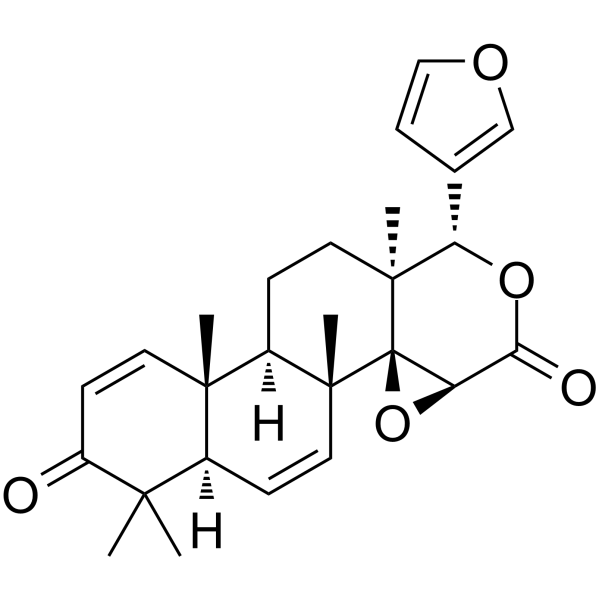 0 ImagesSynonyms: 7-Desacetoxy-6,7-dehydrogedunin7DG (7-Desacetoxy-6,7-dehydrogedunin) is a PKR inhibitor, P2X7 purinergic receptor inhibitor, and skin-lightening agent. 7DG binds outside the ATP-catalytic domain of PKR, blocks the kinase activity-independent protein-protein interactions of PKR, inhibits the phosphorylation and activity of PKR, disrupts ASC assembly and caspase-1 activation, and suppresses the activation of the NLRP1 inflammasome. 7DG inhibits pyroptosis, suppresses the ATP-P2X7 signaling pathway, and abolishes ATP-induced increases in the expression levels of MITF, tyrosinase, PMEL/gp100, and melanin content. 7DG exerts skin-lightening effects in cultured skin in vitro. 7DG can be used in research related to chronic obstructive pulmonary disease, gout, type 2 diabetes, Alzheimer's disease, and hyperpigmentary skin disorders.
-
PKR1 antagonist 1
 0 ImagesCat. No.: HY-159972CAS No.: 910113-60-9PKR1 antagonist 1 (PC1) is a potent PKR1 antagonist. PKR1 antagonist 1 reduces hyperalgesia and allodynia in SNI mice.
-
PKRA83 hydrochloride
 0 ImagesCat. No.: HY-147056BSynonyms: PKRA7 hydrochloridePKRA83 (PKRA7) hydrochloride is a potent PK2 antagonist that competes for PK2 binding to its receptors, PKR1 and PKR2. PKRA83 hydrochloride potently inhibits PK2 receptors with IC50 values of 5.0 nM and 8.2 nM for PKR1 and PKR2, respectively. PKRA83 hydrochloride exhibits anticancer, antiarthritis, and antiangiogenic activities.
-
PKR1 antagonist-2
 0 ImagesCat. No.: HY-153201CAS No.: 910113-34-7PKR1 antagonist-2 is a non-peptide prokineticin receptor antagonist that preferentially binds to and blocks PK-R1 signaling while also blocking PK-R2. PKR1 antagonist-2 shifts the autoimmune response against myelin from a Th1/Th17 profile toward a Th2 profile, reducing myelin antigen-specific T cell proliferation and the production of proinflammatory cytokines (IFN-γ, TNF, IL-6, IL-17), and increasing the levels of anti-inflammatory cytokines IL-4/IL-10. PKR1 antagonist-2 significantly alleviates disease severity in relapsing-remitting and chronic experimental autoimmune encephalomyelitis (EAE). PKR1 antagonist-2 can be used in research related to multiple sclerosis .
-
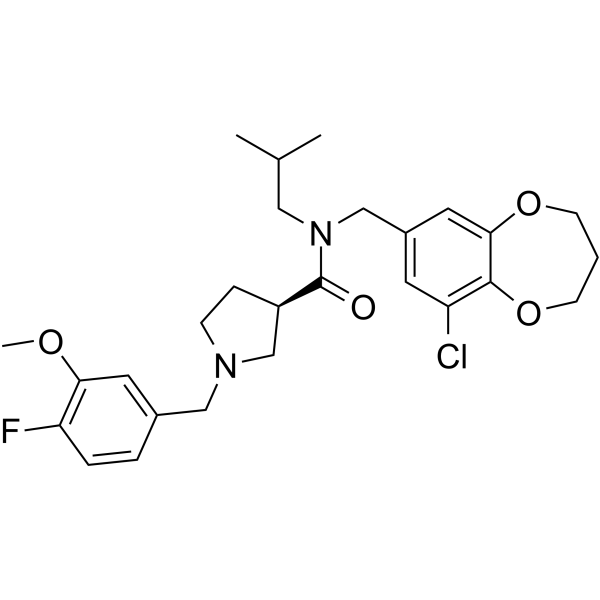
A457
 0 ImagesCat. No.: HY-129317CAS No.: 1233923-95-9A457 is a prokineticin receptor PKR2 antagonist, with an IC50 of 102 nM. A457 can rescue the cell surface expression and function of P290S PKR2, but not W178S and G234D PKR2.



